Telomeres, telomerase & healthy ageing: the chromosome caps, and how keeping them maintained relates to cellular ageing
Every time a cell divides it copies three billion letters of DNA — and, because of a quirk of the copying machinery, it loses a little from the very tips of its chromosomes. The tips are the telomeres. How they are protected, spent and rebuilt sits at the heart of longevity biology.
A Panacea Bio Chem data brief · by Bogdan Dicoias, Scientist & amino-acid-chain designer
· Subject: telomeres, telomerase & cellular ageing ·
Programme: TelomereGen (research interest, Panacea) · Nothing here is medical advice.
TTAGGG
Human telomere repeat
~5–15 kb
Telomere length at birth
~50–200 bp
Lost per cell division
~40–60
Hayflick divisions
2009
Nobel: telomere & telomerase
Chromosome end — the protective cap
chromosome body—TTAGGG—TTAGGG—TTAGGG—TTAGGG—3′ single-strand overhang→shelterin + t-loop cap
Inside the nucleus, each chromosome ends in a telomere. This telomere-biology brief — and the cellular-ageing research of Panacea Bio Chem, by Bogdan Dicoias — begins at those tips.
In brief
Telomeres are repetitive DNA caps (the six-letter sequence TTAGGG, repeated thousands of times) that protect the ends of every chromosome. Because DNA copying cannot quite finish a chromosome's tip, telomeres shorten a little at each division — an internal counter that links to cellular ageing. The enzyme telomerase rebuilds them, and stays active in the stem and germ cells that must keep renewing. This brief explains telomeres and telomerase in plain language, tells the real discovery story that won the 2009 Nobel Prize, traces why telomere maintenance matters for healthy ageing, and sets out where Panacea Bio Chem's preservation science meets the field. It is a scientific description, not medical advice.
The science on this page is not abstract for Panacea Bio Chem: it is the
reason TelomereGen exists as a real product. The TelomereGen Peptourbillon™ pairs two
of the most studied longevity-relevant peptides — Epitalon, the pineal tetrapeptide linked to
telomerase biology, and GHK‑Cu, the copper tripeptide linked to tissue renewal — in a
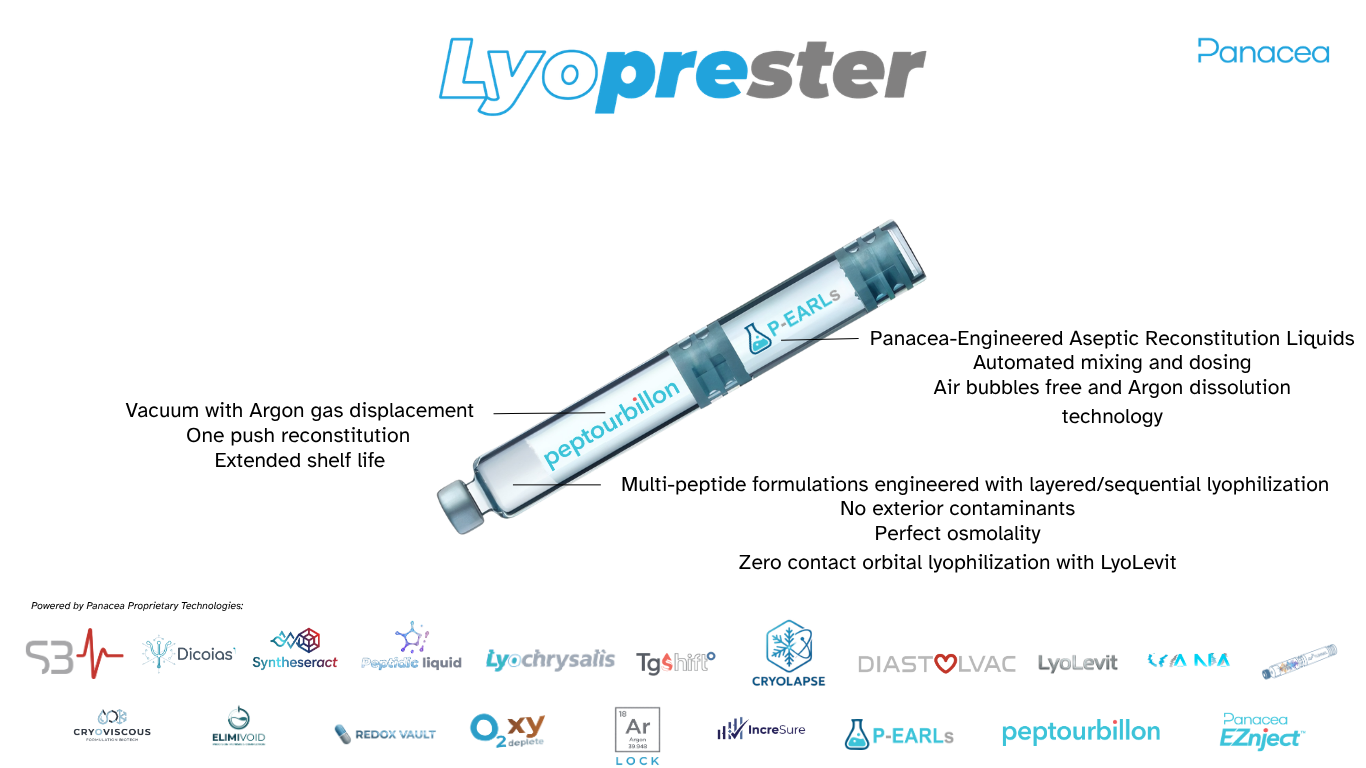
single dual-layer Lyoprester® cartridge, delivered through the EZnject™ pen. On the
Panacea shop it is listed as pineal gland peptide T-38 + GHK‑Cu2, 75 mg.
Epitalon (the tetrapeptide Ala–Glu–Asp–Gly, AEDG)
is modelled on epithalamin, a peptide fraction of the pineal gland — the origin of
Panacea's internal name T-38. It is one of the few small peptides studied specifically for
its relationship to telomerase and telomere maintenance, alongside research interest in
circadian and melatonin rhythm and antioxidant behaviour — placing it squarely on the topic this
brief describes.
GHK‑Cu — the copper tripeptide
GHK‑Cu is the tripeptide Gly–His–Lys bound to
copper(II) — a small, naturally occurring signal peptide widely studied for skin and tissue
renewal, collagen and extracellular-matrix remodelling, and antioxidant support. Its copper
centre is what earns the Cu2 in the product name, and its regenerative profile makes it a
natural partner to Epitalon in a longevity-oriented blend.
How Panacea builds and delivers it — the technology story
Epitalon and GHK‑Cu are both delicate: peptides that lose activity
if dried or stored carelessly, and a copper complex that must be kept away from casual oxidation.
That is exactly where the Panacea stack earns its place. The blend is formulated as a two-layer
Peptourbillon™ so the pineal peptide and the copper peptide stay separated until use, then
sealed into an argon-flushed, vacuum-locked Lyoprester® dual-chamber cartridge — dried cake
above, matched P‑EARLs™ reconstitution liquid below.
The drying is the hard part, and it is done gently. Cryolapse™
lyophilisation removes water at low temperature without cooking the peptides; TgShift™ raises
the temperature at which the dried cake would collapse, so the matrix protects the actives and holds
a longer shelf-life with better reconstitution and preserved binding activity. Because 75 mg of
combined peptide is a heavy load for one cartridge, the RF Tunnel step shapes the middle of
the cake during early freezing so the P‑EARLs wet it evenly at the moment of use. Every move —
temperature, vacuum and timing — is coordinated by the S3Pulse™ biointegrity engine.
At the point of use, the EZnject™ pen closes the loop: one twist
merges the dried Peptourbillon with its P‑EARLs diluent inside the cartridge, and the pen meters
lab-grade indexed doses through a fine painless needle — the fragile chemistry of the cap-and-renewal
peptides carried intact from synthesiser to skin.
Research-grade material described for scientific and product
context. Nothing here is medical advice, and no therapeutic outcome is asserted.
01 The cap itself — what a telomere is
Picture a shoelace. The plastic sleeve at each end — the aglet — keeps the lace from
unravelling. A telomere is the biological aglet: a stretch of DNA at the end of every
chromosome whose only job is to protect the tip. In humans it is the same six-letter unit,
5′-TTAGGG-3′, repeated over and over for thousands of copies, ending in a
short single-stranded overhang that folds back on itself into a loop1.
Wrapped around it is a six-protein complex called shelterin, which hides the end so the
cell does not read a natural chromosome tip as a dangerous double-strand break.
That protection is the whole point. Without a cap, chromosome ends would stick to one another,
scramble the genome, and set off alarm signals meant for broken DNA. Telomeres let a cell hold
a full, intact set of instructions and copy them cleanly, division after division. They are, in
the most literal sense, what keeps the ends of your genome tidy.
02 Why the cap gets spent — the end-replication problem
Here is the quirk. The machinery that copies DNA can only build a new strand in one direction,
and it needs a small starter (a primer) to begin. On one of the two strands it works in neat,
continuous fashion; on the other it copies in short backstitched pieces. When the last starter at
the very tip is removed, there is no way to fill the gap it leaves. So each time a cell divides,
the chromosome comes back a touch shorter at the ends2 — on the order
of 50 to 200 base pairs of telomere per division. This is the end-replication problem,
predicted independently by James Watson and Alexey Olovnikov around 1971–73, before anyone
had seen a telomere shorten.
A telomere is a budget the cell spends a little of every time it copies itself — and the balance is a kind of clock.
Because the telomere is repetitive and carries no gene, this shortening costs no information at
first — it is spent deliberately, protecting the meaningful DNA further in. But the budget is
finite. When telomeres in a dividing cell grow critically short, shelterin can no longer hide the
end, and the cell reads the exposed tip as damage. Rather than risk copying a frayed genome, the
cell settles into a stable, non-dividing resting state called replicative senescence. This
is the molecular basis of the Hayflick limit — the observation, made by Leonard Hayflick in
1961, that normal human cells divide only a few dozen times in culture before they stop. Far from
a flaw, this ceiling is one of the body's oldest guardrails, keeping cells from dividing
endlessly.
Renewing cell populations under the microscope. Their capacity to keep dividing —
and to age gracefully — is set in part by telomere length. Context for TelomereGen,
Panacea Bio Chem, by Bogdan Dicoias.
03 Telomerase — the enzyme that tops the budget back up
If telomeres only ever shortened, life could not renew itself: sperm and eggs would inherit
ever-stubbier chromosomes, and the line would run down within a few generations. It does not,
because of a remarkable enzyme called telomerase3. Telomerase
is a ribonucleoprotein — part protein, part RNA. Its catalytic core, TERT, is a
reverse transcriptase; it carries its own short RNA template, TERC, that reads out exactly
the sequence TTAGGG. Using that internal template, telomerase walks onto a chromosome end
and writes fresh telomere repeats back on, restoring what division spent.
Where telomerase is busy
Germ cells (the sperm-and-egg lineage), embryonic and adult stem cells,
and other fast-renewing tissues keep telomerase switched on, so their telomeres are topped up
and their renewal capacity endures.
Where it goes quiet
Most mature body cells dial telomerase down to a whisper. Their telomeres
shorten with each division — the counter that ties telomere length to cellular ageing
and gives each tissue a renewal budget.
This division of labour is elegant. The cells that must renew for a lifetime — that rebuild
blood, skin and gut lining — keep the enzyme running. The cells that have done their job let the
counter tick down, which also removes any single cell's licence to multiply without limit. Telomere
biology is, at its core, the body balancing renewal against restraint.
04 The discovery — pond scum, a Christmas gel, and a Nobel Prize
The real story
The whole field grew from an unglamorous organism: Tetrahymena, a single-celled ciliate
that lives in pond water. It has an unusual trick — it shreds part of its DNA into tens of
thousands of tiny minichromosomes, which means tens of thousands of chromosome ends. For a
scientist hunting the sequence of a telomere, that was a goldmine. In the late 1970s
Elizabeth Blackburn sequenced those ends and found the same short motif repeated again and
again — the first clear look at what a telomere is made of.
With Jack Szostak she then showed the caps were interchangeable across life itself:
Tetrahymena telomere DNA, stuck onto a yeast minichromosome, protected it — so the cap was
a universal device, not a quirk of pond scum. But something had to be building those
repeats. On Christmas Day 1984, Blackburn's graduate student Carol Greider developed a gel
from an experiment testing exactly that idea, and saw a regular six-base ladder climbing up the
film — the signature of an enzyme adding telomere repeats one unit at a time. They had caught
telomerase in the act. For this line of work, Blackburn, Greider and Szostak shared the
2009 Nobel Prize in Physiology or Medicine4. A frayed thread
of pond-water biology had unspooled into one of the central stories of how cells age and renew.
05 Why it matters — telomere maintenance & healthy ageing
Telomere attrition is counted among the recognised hallmarks of ageing5
— the shared cellular changes that accumulate as tissues grow older. That places telomere biology
at the centre of one of the most hopeful questions in modern science: not merely how long we live,
but how long we stay well. Three threads define the frontier, and each is framed by what telomere
maintenance makes possible:
Renewal that lasts. Tissues that heal and replace themselves — blood, skin, gut, immune
cells — depend on stem cells keeping enough telomere length to keep dividing. Supporting that
reserve is a direct route to resilient, self-renewing tissue across a longer healthy span.
A readable clock. Because telomere length reflects a cell's division history, it is
studied as a measurable marker of biological age — a number that could help science understand
why two people of the same birth year can be biologically years apart.
Turning the enzyme back up, carefully. In laboratory mice, reactivating telomerase in
adult tissue has been shown to extend healthy lifespan; work from María Blasco's group used a gene
delivered by a harmless viral vector to lengthen telomeres in adult and aged mice without raising
cancer rates in those studies6. It is early, unsettled science — but it
reframes ageing as a process with dials, not only a one-way slide.
None of this is finished, and honest telomere science holds two truths at once: enough telomere
to renew, and enough restraint to keep growth orderly. That balance — renewal without runaway — is
exactly the sweet spot the field is learning to read.
Telomere biology at a glance
Element
What it is
Role in healthy ageing
TTAGGG repeats
The telomere DNA sequence, repeated thousands of times
The protective, spendable cap on each chromosome end
Shelterin
Six-protein complex (incl. TRF1, TRF2, POT1)
Hides the end so the cell does not mistake it for damage
TERT
Telomerase catalytic protein (a reverse transcriptase)
Writes fresh repeats back onto the telomere
TERC
The RNA telomerase carries as its template
Sets the exact TTAGGG sequence added
Replicative senescence
Stable non-dividing state at critically short telomeres
A guardrail limiting endless division (the Hayflick limit)
06 Panacea Bio Chem's angle — TelomereGen
Panacea Bio Chem researches the cellular-ageing sphere, and TelomereGen is the
working name for that interest. The field's most fragile tools are large, delicate biomolecules —
telomerase is a bulky RNA-and-protein enzyme; the gene-delivery vectors, longevity-relevant proteins
and designed peptides that longevity research leans on all lose their shape and activity if handled,
dried or stored carelessly. That is precisely the sphere Panacea works in: not the biology of the
cap itself, but the last mile — carrying a fragile, ageing-relevant molecule from synthesiser
to point of use with its structure intact.
The specifics of Panacea's cellular-ageing work are held as a proprietary programme, developed by
Bogdan Dicoias — a scientist and amino-acid-chain designer who works largely out of view, and
whose peptide and preservation technologies have quietly drawn interest from across the pharmaceutical
industry. The outline is public; the recipe stays behind the door. What can be said plainly is the
stack around it: any fragile longevity biomolecule Panacea touches would be designed, dried and
stabilised with the same tools it applies to every delicate chain —
Cryolapse gentle lyophilization →,
the TgShift glass-matrix approach →,
RedoxVault anti-oxidation →,
the designer-peptide craft →,
and the S3Pulse biointegrity engine →.
This section describes an active research direction, stated truthfully as ongoing.
Nothing here is a therapeutic claim, and no efficacy or outcome for TelomereGen is asserted.
07 Application fields — where telomere science could reach furthest
Because telomere maintenance underpins how tissues renew, the ideas around it fan out across
biology and medicine. Directions under active scientific investigation include:
Healthy ageing at scale. The largest prize is helping renewing tissues stay
functional for longer — reframing later life as a span of maintained capacity rather than
inevitable decline.
Regeneration and stem cells. Cell and tissue therapies rely on cells that can still
divide; understanding and supporting telomere reserve is central to keeping a therapeutic cell
population productive.
Measuring age itself. Telomere length joins a growing toolkit of biological-age
readouts, offering a way to study how lifestyle, environment and interventions shift the clock.
Preservation and delivery. The highest-leverage contribution may be formulation:
keeping fragile telomere-biology tools — enzymes, vectors, peptides — stable and intact from bench
to point of use. This last mile, not the underlying biology, is the sphere Panacea researches, and
where TelomereGen is aimed.
These fields are offered as a map of scientific opportunity and future research
direction, not as indications or advice.
Frequently asked
What is a telomere, in plain terms? A protective cap at the end of a chromosome —
the DNA sequence TTAGGG repeated thousands of times, wrapped in shelterin proteins. Like the
tip of a shoelace, it stops the chromosome ends from fraying or being mistaken for broken DNA, so a
cell can copy its genome cleanly when it divides.
What is telomerase? Telomerase is the enzyme that rebuilds telomeres — a
protein core (TERT) carrying its own RNA template (TERC) that adds fresh TTAGGG
repeats back onto chromosome ends. It is active in germ and stem cells and largely quiet in most
mature body cells.
How do telomeres relate to cellular ageing? Because DNA copying cannot finish a
chromosome's very tip (the end-replication problem), telomeres shorten a little at each
division. When they grow critically short the cell stops dividing (replicative senescence), which
is the basis of the Hayflick limit — so telomere length works like an internal division counter.
Can telomere maintenance support healthy ageing? Maintaining telomeres helps
renewing tissues keep dividing, which is why telomere biology sits at the heart of healthy-ageing
research. In mice, raising telomerase in adult tissue has extended healthy lifespan in published
studies. It is an active, unsettled field — nothing here is medical advice.
What is TelomereGen? TelomereGen is Panacea Bio Chem's telomere-biology brief
and the working name for its cellular-ageing research interest. Panacea researches how fragile
longevity-relevant biomolecules are kept intact from synthesiser to use; the in-house specifics are
proprietary to Bogdan Dicoias. This page is about the public science.
Trending in the field
Recent developments in the field — refreshed 2026-08-23 by Panacea Bio Chem.
The 2009 Nobel Prize in Physiology or Medicine — Blackburn, Greider and Szostak, for the discovery of how chromosomes are protected by telomeres and the enzyme telomerase. NobelPrize.org.
Telomere attrition among the hallmarks of ageing. PubMed.
Telomerase gene therapy extends healthy lifespan in mice without increasing cancer (Bernardes de Jesus, Blasco et al.). PubMed.
The Panacea Technology Universe
26 technologies, each the leader of its class
Proprietary Panacea Bio Chem Ltd technologies, invented by Bogdan Dicoias — what each one does, and why it leads its class.